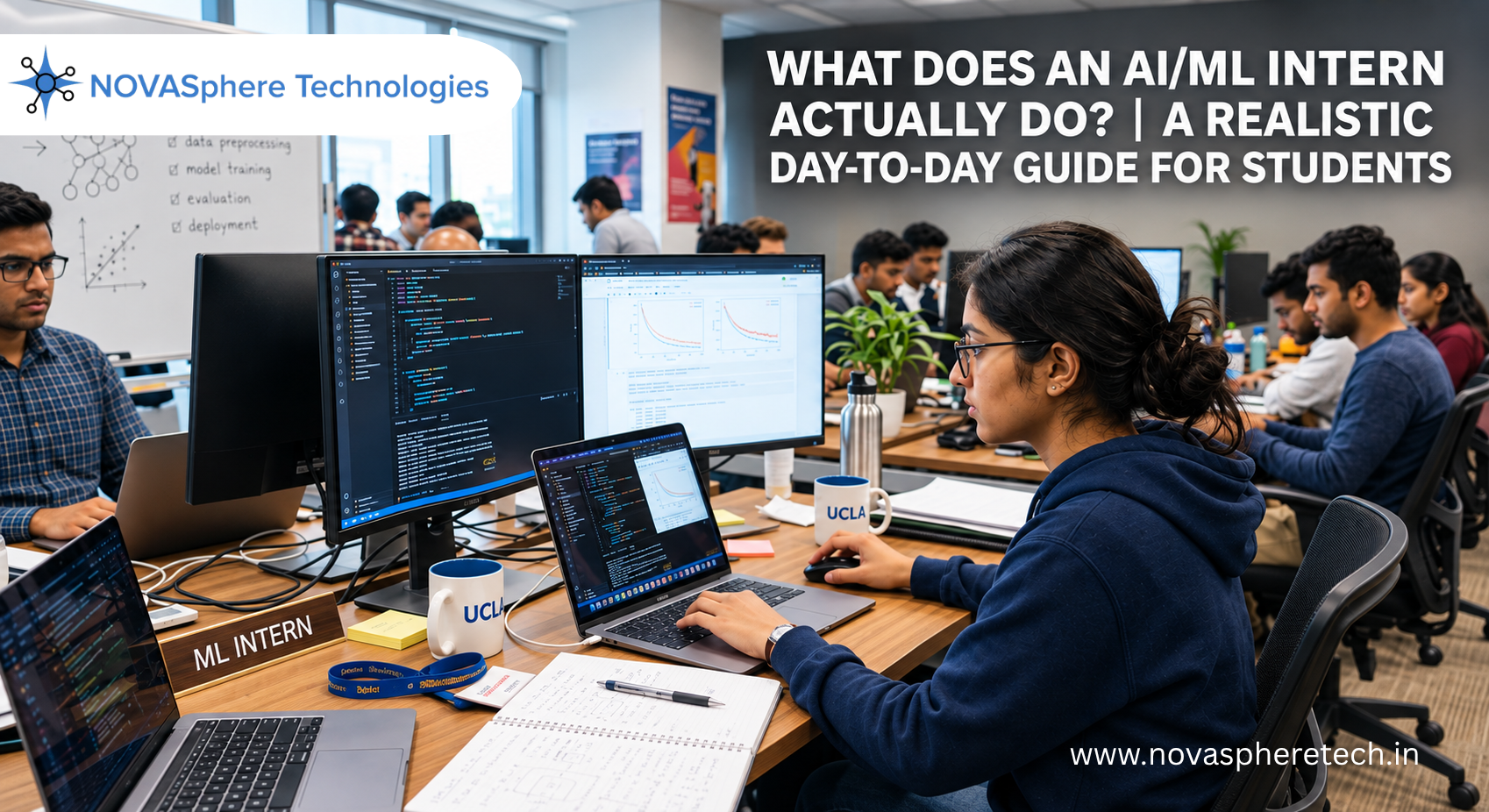
If you are a student interested in artificial intelligence and machine learning, you have probably searched for “AI/ML intern” roles and wondered what actually happens after you get selected.
Do AI/ML interns spend the whole day building advanced AI models? Do they need to know deep learning before starting? Are internships mostly about coding, or do interns also work with real datasets and business problems?
The reality is more practical.
An AI/ML intern usually spends their time learning how machine learning works in real projects, preparing data, writing Python code, experimenting with models, analyzing results, fixing errors, documenting their work, and working with mentors or development teams.
An AI/ML internship can therefore be very different from simply completing machine learning tutorials or college assignments.
At NovaSphere Technologies LLP, an internship can be viewed as an opportunity for students to connect their academic knowledge with practical project experience and understand how AI/ML concepts are applied in real-world situations.
In this guide, let's look at what an AI/ML intern actually does during a typical internship.
What Is an AI/ML Intern?
An AI/ML intern is a student or beginner who works with artificial intelligence and machine learning technologies under the guidance of experienced professionals.
The exact responsibilities depend on the organization and the intern's skill level. A beginner may start with data cleaning, Python programming, research, and simple machine learning models, while an advanced intern may work on predictive modeling, natural language processing, computer vision, or deep learning.
The main goal is not necessarily to build the most complicated AI system. Instead, an AI/ML internship helps students understand the complete machine learning workflow:
Learning this workflow is one of the most valuable parts of an AI/ML internship.
What Does an AI/ML Intern Do on a Daily Basis?
A typical day is not exactly the same for every intern. However, several activities are common across machine learning internship programs.
1. Start by Understanding the Project
Before writing code, an AI/ML intern needs to understand the problem. For example, suppose a company wants to predict whether a customer is likely to purchase a product. An intern may need to understand:
-
What is the business problem?
-
What data is available?
-
What should the model predict?
-
Which factors could influence the prediction?
-
How will model performance be measured?
This step teaches an important lesson: machine learning is not only about coding. Understanding the problem is equally important.
2. Work With Real Datasets
Data is one of the biggest parts of an AI/ML project. An intern may receive a dataset containing thousands of rows and multiple columns. The data might include missing values, duplicate records, incorrect formats, or irrelevant information. Common tasks include:
-
Loading datasets using Python
-
Understanding columns and data types
-
Finding missing values
-
Removing duplicate records
-
Handling inconsistent data
-
Converting categorical data
-
Preparing training and testing datasets
Tools such as Pandas and NumPy are commonly used for these tasks. For many students, this is where an AI/ML internship feels different from classroom learning because real-world data is rarely perfectly organized.
3. Perform Data Analysis and Visualization
After cleaning the data, an AI/ML intern may analyze it to identify patterns and relationships. For example, an intern might investigate:
-
Which variables are most important?
-
Are there unusual values?
-
Is the dataset balanced?
-
Which categories appear most frequently?
-
Are two variables strongly related?
Python libraries such as Matplotlib and other data visualization tools can help interns understand the dataset visually. Charts, graphs, distributions, and correlation analysis can make complex datasets easier to understand. This stage is often called exploratory data analysis (EDA).
4. Select and Prepare Features
Not every column in a dataset is useful for a machine learning model. An intern may need to identify relevant features and prepare them for model training. This can involve:
-
Feature selection
-
Feature engineering
-
Encoding categorical variables
-
Scaling numerical values
-
Transforming data
-
Removing unnecessary features
For example, if a dataset contains customer information, the intern may discover that certain variables are useful for prediction while others provide little value. This process helps students understand why good machine learning results depend heavily on good data preparation.
5. Train Machine Learning Models
Once the dataset is ready, the intern can begin experimenting with machine learning algorithms. Depending on the project, an intern may work with algorithms such as:
-
Linear Regression
-
Logistic Regression
-
Decision Trees
-
Random Forest
-
K-Nearest Neighbors
-
Support Vector Machines
-
Clustering algorithms
For beginners, Scikit-learn is one of the most useful Python libraries for learning and implementing traditional machine learning models. The goal isn't simply to run a model. An intern needs to understand why a particular algorithm is being used and what its results mean.
6. Evaluate the Model
Training a model is only one part of the job. An AI/ML intern also needs to determine whether the model is performing well. Depending on the problem, evaluation may involve metrics such as:
-
Accuracy
-
Precision
-
Recall
-
F1-score
-
Mean Absolute Error
-
Mean Squared Error
-
Confusion matrix
For example, a classification model with high accuracy may still perform poorly on an imbalanced dataset. This is why interns learn to look beyond a single number and understand the context behind model performance.
7. Experiment and Improve the Model
Machine learning projects rarely work perfectly on the first attempt. An AI/ML intern may experiment with:
-
Different algorithms
-
Different features
-
Hyperparameters
-
Data preprocessing techniques
-
Training strategies
-
Different evaluation methods
The intern then compares the results and documents what changed. This experimentation process is an important part of developing practical machine learning skills. It also teaches students that debugging and experimentation are normal parts of AI/ML development.
8. Work With a Mentor or Team
An internship isn't supposed to be completely independent work. AI/ML interns commonly communicate with mentors, senior developers, data scientists, or other interns. A normal day may include:
-
Discussing project progress
-
Asking technical questions
-
Reviewing code
-
Receiving feedback
-
Explaining model results
-
Attending team meetings
-
Planning the next task
Communication is therefore an important AI/ML intern skill. Being able to explain what you did and why you did it can be just as valuable as writing the code itself.
9. Document the Work
Documentation is another task students sometimes underestimate. An intern may need to document:
-
Dataset information
-
Data preprocessing steps
-
Algorithms used
-
Model parameters
-
Results
-
Challenges
-
Improvements
-
Future possibilities
They may also maintain code using Git and GitHub. Good documentation makes it easier for another person to understand and reproduce the project.
What Projects Can an AI/ML Intern Work On?
The projects depend on the organization, internship level, and available datasets. Some common AI/ML internship projects include:
Beginner-Level Projects
-
House price prediction
-
Student performance prediction
-
Customer churn prediction
-
Spam email classification
-
Sales forecasting
-
Movie recommendation systems
Intermediate Projects
-
Sentiment analysis
-
Customer segmentation
-
Fraud detection
-
Recommendation systems
-
Demand prediction
-
Image classification
Advanced Projects
-
Natural language processing applications
-
Computer vision systems
-
Chatbot development
-
Deep learning applications
-
Object detection
-
Generative AI applications
The important thing is not how impressive the project title sounds. A strong internship project should demonstrate that the student understands the problem, data, methodology, implementation, evaluation, and limitations.
Which Skills Should an AI/ML Intern Have?
You don't necessarily need to master everything before applying for an AI/ML internship for students. However, having a foundation in the following areas can make the internship easier.
Technical Skills
-
Python: Python is one of the most commonly used programming languages for AI and machine learning.
-
Statistics: Basic concepts such as mean, probability, distributions, correlation, and variance are useful.
-
Machine Learning: Understand supervised learning, unsupervised learning, classification, regression, and model evaluation.
-
Data Handling: Learn how to work with datasets using Pandas and NumPy.
-
Data Visualization: Understand how to create and interpret charts and graphs.
-
Machine Learning Libraries: Familiarity with Scikit-learn is useful. Students working on advanced projects may also encounter TensorFlow or PyTorch.
-
Git/GitHub: Basic version control knowledge can help students manage and share their projects.
What Does a Beginner's First Week Look Like?
The first week of an AI/ML internship may not involve building an advanced neural network. Instead, you might spend your first few days:
-
Understanding the organization and project
-
Setting up your development environment
-
Reviewing Python and machine learning concepts
-
Exploring an existing dataset
-
Learning the project's requirements
-
Understanding the codebase or project structure
-
Completing a small assigned task
-
Discussing your progress with a mentor
This gradual approach is useful because students need time to understand the tools, workflow, and expectations.
What an AI/ML Intern Usually Does NOT Do
There are also some common misconceptions about AI/ML internships. An intern usually does not spend every day creating cutting-edge AI models from scratch. You may spend considerable time on:
-
Data cleaning
-
Reading documentation
-
Debugging code
-
Searching for errors
-
Testing different approaches
-
Preparing datasets
-
Writing reports
-
Attending meetings
-
Improving existing code
These tasks may sound less exciting than “building AI,” but they are essential to real machine learning work. Understanding this reality can help students enter an internship with realistic expectations.
AI/ML Internship vs College Project: What's Different?
A college project often has a fixed scope and deadline. An internship can provide exposure to a more structured development environment. During an internship, students may experience:
| College Project | AI/ML Internship |
|---|---|
| Mainly academic | More practical |
| Limited datasets | Potentially larger or messier datasets |
| Individual work | Team collaboration |
| Fixed requirements | Requirements may evolve |
| Focus on submission | Focus on implementation and learning |
| Teacher evaluation | Mentor/team feedback |
The experience varies by organization, but internships can help students understand how technical knowledge is applied beyond the classroom.
How to Make the Most of an AI/ML Internship
If you're preparing for an AI/ML internship for freshers, don't focus only on collecting certificates. Try to build evidence of your actual skills.
Build 2–3 Practical Projects
Create projects that demonstrate your ability to work with data, build models, and explain results.
Keep Your GitHub Organized
Upload meaningful projects with:
-
README files
-
Project explanations
-
Requirements
-
Code
-
Results
-
Screenshots where appropriate
Ask Questions
Don't hesitate to ask your mentor when you don't understand something. Good questions can accelerate your learning.
Keep a Learning Journal
Record what you learned, what problems you faced, and how you solved them.
Understand Your Own Projects
You should be able to explain your project without simply reading the code. Interviewers may ask:
-
“Why did you choose this algorithm?”
-
“How did you clean the data?”
-
“Which evaluation metric did you use and why?”
Being able to answer these questions demonstrates practical understanding.
What Can You Learn From an AI/ML Internship?
A well-structured internship can help students develop several skills simultaneously. You can gain experience in:
-
Python programming
-
Machine learning
-
Data analysis
-
Model evaluation
-
Problem-solving
-
Research
-
Git/GitHub
-
Team collaboration
-
Technical communication
-
Project documentation
At NovaSphere Technologies LLP, the goal of an AI/ML internship can be to help students move beyond theoretical concepts and gain exposure to practical AI/ML workflows and project-based learning.
Is an AI/ML Internship Worth It for Students?
For students interested in artificial intelligence, machine learning, data science, or related technical careers, an internship can provide practical exposure that complements academic learning.
The biggest benefit isn't simply having “AI/ML Intern” written on a resume. The real value comes from being able to explain:
-
What problem you worked on
-
What data you used
-
What tools you used
-
What machine learning approach you followed
-
What challenges you faced
-
How you evaluated the model
-
What you learned
That practical experience can make your portfolio and future technical discussions more meaningful.
Final Thoughts
An AI/ML intern does much more than simply train machine learning models. A realistic internship can involve understanding a problem, collecting or exploring data, cleaning datasets, writing Python code, training models, evaluating results, debugging errors, documenting work, and communicating with mentors and teammates.
For students, this experience can provide an important bridge between learning AI/ML concepts and applying them to practical projects.
If you're considering an AI/ML internship, don't worry about knowing every algorithm before you begin. Focus on building a strong foundation, improving your Python skills, understanding machine learning fundamentals, and developing the ability to solve problems step by step.
At NovaSphere Technologies LLP, students can use internship-based project experience as an opportunity to strengthen their technical foundation, explore real-world AI/ML workflows, and build practical skills for their future career.